There is a woman in the Atlas Mountains sitting beside a loom. No pattern sheet in front of her. No digital template on a screen. Just wool, memory, and two hands that have done this thousands of times before. She learned this craft from her mother. Her mother learned it from hers. And the rug taking shape beneath her fingers carries a story that goes back over 2,000 years.
This is not factory production. This is a living tradition — one that Berber women (also called Amazigh women) have kept alive through generations of oral teaching, hands-on practice, and deep cultural pride. Every handmade Moroccan rug from Moroccan Rug Area begins exactly this way. Understanding the process changes how you see the rug on your floor.
The Women Behind the Craft
Berber tribes, primarily from Morocco’s Middle Atlas Mountains and High Atlas Mountains, developed rug weaving as both a practical necessity and an art form. In cold mountain climates, thick wool rugs provided warmth. Over time, the craft grew into something far deeper — a visual language through which women recorded their experiences, beliefs, and identities.
The skill passes from mother to daughter at home. No formal classroom. No certification. A young girl watches, tries, fails, and tries again. By the time she reaches adulthood, the motion is instinct. The symbols she weaves carry meanings she absorbed before she could fully articulate them. This oral and hands-on transmission is exactly what makes each authentic Moroccan rug irreplaceable. No machine can replicate knowledge passed through touch.
Step 1: Shearing the Wool in Spring
The process begins long before anyone touches a loom. Every April, sheep grazing in the Atlas Mountains get their annual shear. This is not a routine task — it carries ritual significance. Communities gather, volunteers assist, and the event marks the start of the weaving season.
The wool from Atlas sheep is prized for a specific reason. High altitude grazing, cold temperatures, and natural pasture produce fibers that are dense, durable, and naturally soft. This is the raw material behind every Beni Ourain, Azilal, and Boujaad rug. The quality starts here, on the mountainside, before a single knot gets tied.
Step 2: Cleaning, Carding, and Spinning
Raw wool is dirty. It contains lanolin, dirt, and debris from months of outdoor living. Berber women wash it by hand, dry it under the sun, and then card it — a process of combing the fibers to align them before spinning.
Spinning transforms loose wool into usable thread. The traditional tool for this is the “Izdi,” a hand spindle that the weaver rotates between her thumb and forefinger. She draws fiber from the raw wool with her left hand and feeds it onto the spinning Izdi with her right. The resulting thread, wound into a bundle called “Afskar,” forms the building block of the entire rug.
This stage alone takes considerable time. A single rug requires hundreds of meters of hand-spun thread. The consistency of the spin directly affects the texture and durability of the finished piece.
Step 3: Natural Dyeing
Before synthetic dyes existed, Berber women extracted color from plants, fruits, spices, and minerals found in their local environment. Saffron produced golden yellows. Henna gave warm reds and oranges. Pomegranate rinds created earthy tones. Indigo brought deep blues.
Many of these dye recipes remain in use today and pass down through families the same way the weaving technique does — orally, from woman to woman. The dye process involves boiling the wool in large pots with the natural pigment, sometimes adding a mordant like alum to fix the color. The result is a depth of tone that synthetic dyes rarely achieve. Natural-dyed wool also ages beautifully, developing a patina rather than fading flatly.
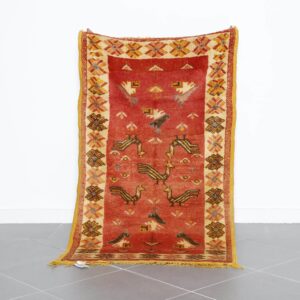
Different tribes carry different color traditions. Azilal rugs typically feature bright, expressive colors woven through undyed wool backgrounds. Beni Ourain rugs stay close to natural ivory and charcoal. Boujaad rugs lean into warm reds and pinks. The palette is not random — it is regional identity made visible.
Step 4: Setting Up the Loom
The loom, called “azta” in the Tamazight language, anchors the entire weaving process. In many Atlas households, the loom sits fixed to the wall of the main living space. It becomes part of the home itself.
The warp — vertical threads running the length of the rug — stretches between the top and bottom beams of the loom. These threads form the structural skeleton. The weaver sets their tension carefully. Loose warp produces a floppy rug. Too tight, and the knots will not seat properly.
Setting up the loom for a large rug takes hours. The process requires precision. Every thread must sit at the correct tension and spacing. This invisible groundwork determines the final quality of the piece.
Step 5: Weaving and Knotting
Now the rug takes shape. The weaver sits at the base of the loom and begins working upward, row by row. Two primary techniques define Moroccan handmade rugs.
Pile weaving involves tying individual wool knots around pairs of warp threads. The weaver cuts each knot to a specific length, creating the thick, soft surface associated with rugs like the Beni Ourain. After every row of knots, she passes a weft thread horizontally across the loom and beats it down with a weaving comb called a “Tazatcha” to compact the work. This comb is a personal tool — Berber tradition holds that a woman does not lend it to another, as it carries her weaving identity.
Flatweave (also called kilim weaving) skips the pile knots entirely. The weft thread weaves back and forth between the warp threads without cutting, producing a thinner, lighter rug with a smooth surface on both sides. Kilim rugs from Morocco show bold geometric patterns and suit warm-climate use.
A medium-sized rug (around 5×8 feet) takes a skilled weaver between two and six weeks to complete, depending on the complexity of the pattern and the weaving technique used.
Step 6: The Symbols Are a Language
Nothing in a Berber rug is decorative by accident. Every geometric shape carries meaning.
Diamonds protect against evil. Zigzag lines represent water, mountains, or fertility. Crosses signal harmony and balance. Triangles connect to femininity and the female life cycle. These symbols do not follow a fixed blueprint — the weaver draws them from memory and personal experience. Two women from the same tribe weaving the same “pattern” will produce two entirely different rugs.
Many Berber weavers believe their rugs carry a spirit — imprinted from the maker’s hands and the life of the wool itself. Some weavers avoid looking at the full rug while it develops, choosing to reveal it only upon completion. The finished piece holds the story of its maker in a form that outlasts memory.
Step 7: Washing and Sun Drying
Once the last knot ties off, the rug goes through a final wash. Cold water loosens the dust embedded during weaving. Wide traditional brooms scrub the surface to clean the weave and reveal the full depth of color and pile. After rinsing, the rug dries flat under direct sunlight. The sun sets the natural dyes and restores the softness of the wool fibers.
This final stage is not cosmetic. The washing and drying process brings out the true character of the rug — its color depth, texture, and structure become fully visible only after this step.
What You Bring Into Your Home
A handmade Moroccan rug is not decor. It is a record. Every knot represents a decision made by a real person — a choice of color, a direction of thread, a symbol pulled from memory. The slight asymmetry you notice in a Berber rug is not a manufacturing error. It is the mark of a human hand working without a machine’s mechanical repetition.
At Moroccan Rug Area, every rug in the collection — from the plush Beni Ourain to the vibrant Azilal to the warm-toned Boujaad — arrives at your door after passing through every step described above. The craft is the same as it was two thousand years ago. The hands are different. The story continues.